
The end of 2019 marks the end of the first phase of Brexit. With a deal passed, the UK will be leaving the EU on 31st January 2020. The future of the country, its economic model and its broader political outlook, will now be determined over years of trade negotiations, including with Trump’s America. Boris Johnson’s strong majority in parliament means that his administration – the successor project to Vote Leave – will get its way on everything, unless there is enough external pressure to force it to change course.
The early days of 2019 were more hopeful. Many of Theresa May’s opponents had spent the last part of 2018 worrying that she would get a deal through parliament, but on January 15th it was subjected to the biggest parliamentary defeat ever inflicted on a government. The defeat of Brexit in parliament was made possible by two voting blocs – the Tory right which insisted on voting against the government; and secondly, and the opposition, who overwhelmingly followed the whip.
Various iterations the same vote took place until Theresa May’s resignation, producing no majority for any course of action or any form of Brexit. The equation changed when Boris Johnson became Prime Minister in July. His primary success was theatrical. In expelling his backbench rebels, issuing ultimatums to parliament, proroguing it, and being defeated in it, he set up a narrative of frustration and antipathy towards the political elite. (As a right wing Etonian, he is apparently magically exempt from this category).
To create the election in which this narrative might become useful, Johnson needed to force the hand of the opposition into calling one. This he did by uniting the hard right of the Tory Party behind what was essentially Theresa May’s Brexit deal, offering them jobs and displaying his Leave-backing credentials. With the help of a few more Labour rebels, who had presumably decided that the time had come for self-immolation, the government got the deal through in principle (at ‘Second Reading’). This tipped the balance, and pushed the Opposition parties into accepting the government’s challenge to a general election.
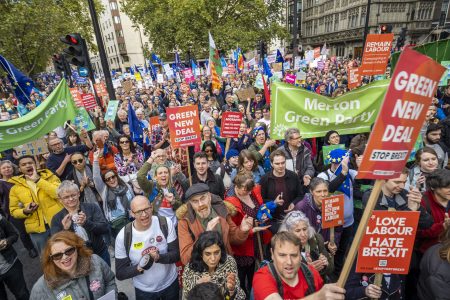
Outside parliament, 2019 was a year of polarisation. As the Tories pushed ahead with a Brexit agenda for which they had no mandate, Remainers and Leavers became more entrenched. By September, 73% of Leave voters backed No Deal. On our side, the anti-Brexit movement mobilised in numbers not seen since the movement against the Iraq War. In March, July and October, hundreds of thousands took to the streets. The left presence on the protests grew substantially during the year, as the rank and file of the labour movement hardened against Brexit and the Green Party continued to mobilise thousands.
The starkest electoral illustration of this polarisation came in May, when the Brexit Party and the Liberal Democrats came first and second in the European elections, beating a Labour Party which remained neutral on Brexit, and a Tory Party which almost refused to run candidates at all. Ultimately, Labour continued to remain neutral, though it did move towards a public vote position in the aftermath of the elections, partly as a result of the work of Another Europe.
The year ended in disaster – but no defeat is total or final, and in the new year we have much to do. Looking back onto our achievements over the past year, we have come a long way, and in the new year we have much to do.
In parliament
- We mobilised around every key vote – from amendments for a public vote, to opposing the various deals put forward by May and Johnson. We focussed on persuading wavering Labour MPs to vote with the whip – by passing motions in their CLPs, providing tools for their constituents to lobby them, and mobilising in their constituencies.
- We helped to set up and run the ‘Love Socialism’ group of left wing anti-Brexit Labour MPs, providing a crucial point of reference for the fight against Brexit in Labour and parliament more widely.
In the streets
- Whenever there was a mass anti-Brexit protest, we mobilised in big numbers. Our ‘left blocs’ attracted many thousands of left wing protesters, bringing trade union banners, green banners, labour banners and grassroots campaigns together on the day. Some of these protests ended with direct action, like the flash occupation of Tory hedge fund donor Odey Capital.
- When Boris Johnson prorogued parliament in August, we led the Stop the Coup movement, which saw hundreds of thousands take to the streets in over 80 cities and towns in mobilisations that took place over a whole week. We provided the logistical backing for the protests, and ensured that a politics of internationalism, free movement and radicalism was at the forefront of the movement.
In Labour
- Throughout 2019, we continued to lead the movement against Brexit in Labour. We didn’t pause for breath after the 2018 conference, and passed hundreds of motions through local parties in the early part of the year, reflecting widespread support for a position of stopping Brexit, transforming Britain, and fighting to defend and extend free movement.
- When it came to Labour conference itself, Brexit again dominated the debate, alongside a range of other motions on the Green New Deal and migration. Our aim was to clarify that Labour would back Remain in a future referendum. We lost this vote, but won a lot on the way. For a full report of what happened, see here.
- Perhaps our proudest policy achievement in Labour was the passing of the Labour Campaign for Free Movement’s fantastic policy, committing Labour to defending and extending free movement, giving migrants the vote, ending no recourse to public funds, and closing all detention centres.
In the field of ideas
- Our podcast has continued to grow in audience and scope, and has produced some fantastic content on everything from Brexit and imperialism, to the result of the general election, to a two-part special on Northern Ireland.
- We’ve released a range of publications on everything from democratic reform, to the experience of the Portuguese left government in challenging the EU institutions.
- In April, alongside the3million and British in Europe, we launched Let Us Vote – a campaign to give equal voting rights to all UK residents and all UK citizens. It gained significant media attention and support from a number of MPs including Clive Lewis and Lloyd Russell-Moyle. Following a conference vote, extending the franchise to all migrants in the UK became Labour policy and made it to its 2019 manifesto.
In ourselves
- We now have over 1300 members, and we’re a fully democratic organisations in which all of our members have a say. Our elected national committee has met more than 20 times, and we’ve had a large annual conference, held just two days after the general election.